


Good morning from the Shinkansen from Osaka to Tokyo.
There is something quietly disarming about writing while moving at that speed. The landscape shifts, the cities thin out and return, and yet inside the train everything remains still, precise, controlled. It feels like a fitting place to reflect.
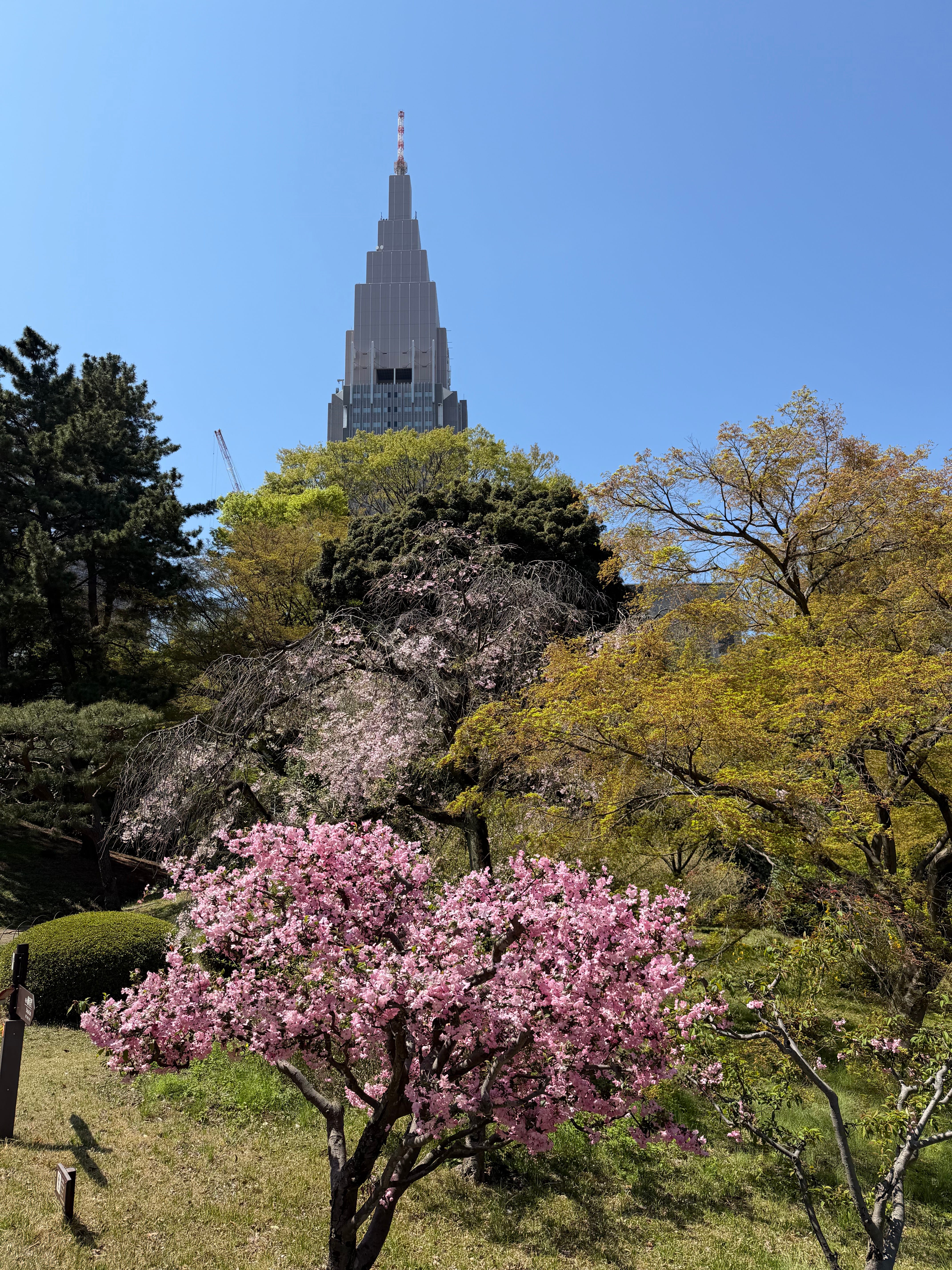
I spent the Easter break in Japan, immersing myself in a culture that is both unique and deeply disciplined, and I arrived at the height of Sakura season.
The cherry blossoms, many of them planted in the years after World War II, bloom for only a brief window each year. A week, perhaps two if conditions allow. That brevity is part of their power. There is an understanding here that beauty is temporary, and therefore must be fully experienced.
What struck me most was not just the blossoms themselves, but how they are observed. Parks are filled with people sitting beneath the trees in a sort of measured joy.
It is also peak tourist season, and it is easy to understand why.
Japan is efficient, structured, and remarkably predictable.
Systems function with a level of reliability that begins to feel almost unreal if you are not used to it. The trains are not late. The taxis operate with precision. The streets are clean in a way that suggests not enforcement, but collective agreement.
Public infrastructure works in a way that makes me (a resident of Joburg) jealous to the core.
https://www.instagram.com/reel/DWtLhC9j5uu/?igsh=MXdlZHRzZWhiMWthNg==
And yet, despite that order, there is a strange dissonance.
Here, it feels as though the noise of global conflict exists only inside my phone.
The wars and the political brinkmanship that is escalating every day all seem distant.
The world, as it is experienced in the news cycle, does not fully penetrate daily life here.
The war in Iran, in particular, feels further away than it does when I am in South Africa.
It may simply be that I am not in a newsroom, not surrounded by screens, not absorbing the relentless urgency of breaking news.
Or perhaps some of it is quite literally lost in translation.
Either way, as I get back to reality, that reality persists.
The situation in Iran is at precarious levels with no clear path forward, and any attempt to predict how it ends would be speculation at best.
US President Donald Trump appears driven by a desire to cement a legacy as a warmonger. His unhinged behaviour is testament to that.
The economist Paul Krugman has gone as far as to accuse him of terrorism, for blowing up civilian infrastructure in Iran and promising to wipe out an entire nation of 90 million people.
The chaos gets worse every day.
It really is a dangerous game of attrition, and Iran is not blinking.
War is unpredictable in many ways but what we know is that the poor get poorer and that instability compounds existing inequality.
We find ourselves on the edge of a world that is being reshaped in real time.
And, predictably, the developing world carries a disproportionate share of the burden.
I will be flying home via Dubai, and it is evident that the United Arab Emirates has already felt the pressure of this conflict.
But the full extent of the economic, political, and social consequences is yet to be understood for Middle East.
It is difficult to avoid the conclusion that a small number of powerful individuals, driven by ego and ambition, can set entire systems into motion with little immediate restraint. The rest of the world, for reasons ranging from complicity to paralysis, allows it to unfold.
At The Debrief Network, we are committed to documenting that impact.
Part of the reason I came to Japan was to create space for thinking.
To step back from the immediacy of the newsroom and consider how we build something more durable.
We have now completed one year. In that time, we have trained ten people to operate as hybrid journalists, capable of both professional reporting and content creation.
Our first news creator cohort has been an instructive one.
We have learned what works, and more importantly, what does not.
The next step is scale.
Journalism is under pressure from multiple directions- whether it’s generative artificial intelligence or shrinking newsrooms.
If the industry is to survive, it will need to adapt without losing its core function.
That tension is what keeps me up at night.
We have invested both time and resources into this work.
Last week we were in Cape Town, reporting on the stories that define everyday life but rarely dominate headlines. There are plans to travel further across the country, to continue documenting realities that are often overlooked.
This is slow and deliberate work. Necessary, really.
Thank you for being part of this journey with us.
Best,
Qaanitah