



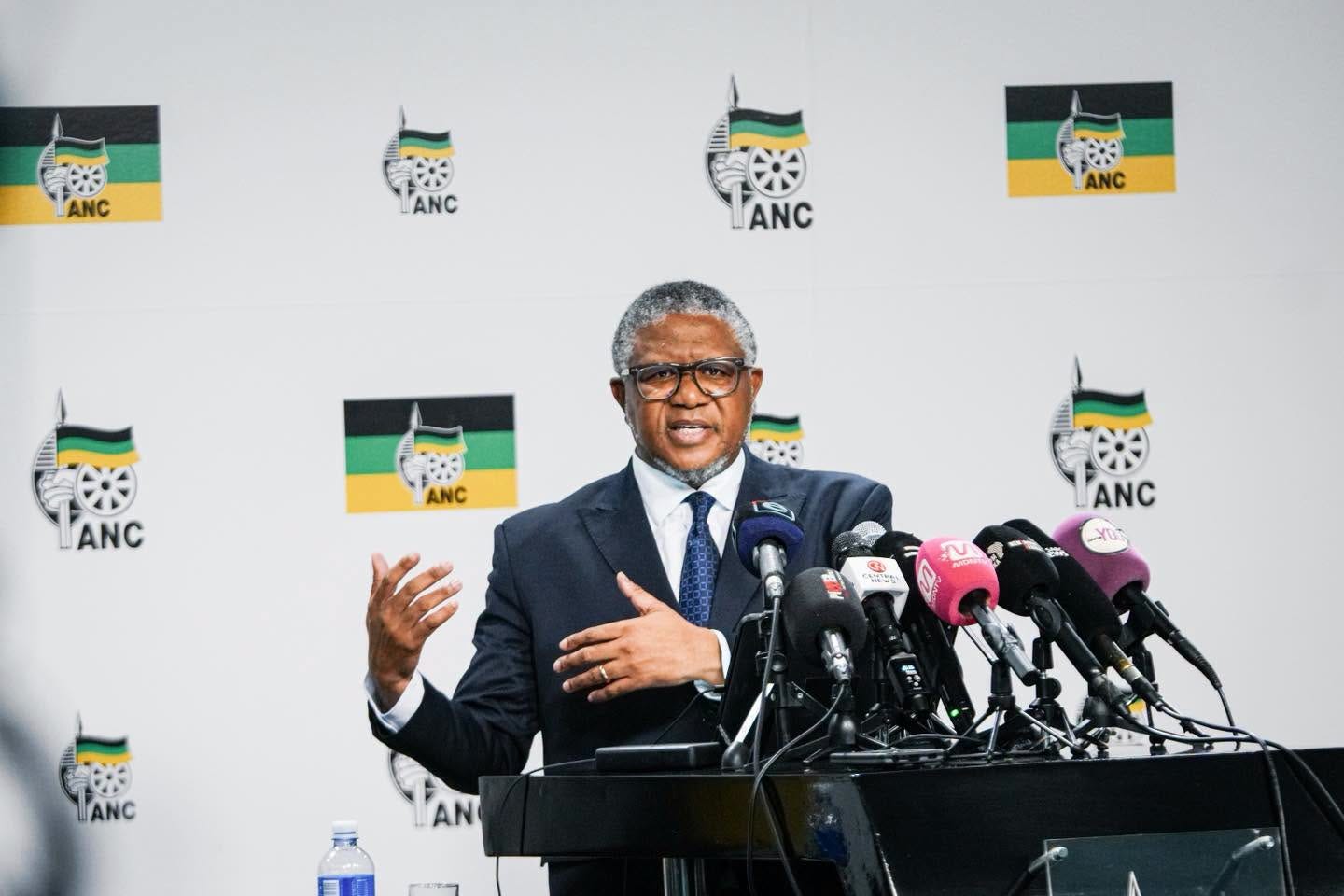
ANC secretary-general Fikile Mbalula has lashed out at just about anyone and everyone after it emerged that the ANC failed to complete the submission of all its candidates for the upcoming municipal elections.
The deadline for parties to submit candidates for the 4 November elections was 17:00 on 28 August.
By the time it arrived, 181 ANC candidates had been captured on the Electoral Commission of South Africa’s online system but had not completed the final electronic submission step. Of those, 130 were on proportional representation lists and 51 were ward candidates.
The ANC initially said it had encountered problems with the electronic system and engaged the IEC about processing the names already captured on it. Mbalula now insists the ANC did not blame the IEC itself for the glitch but is asking the IEC to condone the delay.
The IEC’s position is much simpler: the deadline was the deadline. Capturing information on the system was not the same as finally submitting it.
The ANC has now taken the matter to the Electoral Court, arguing that it is not seeking special treatment and pointing out that it was not alone. In total, 2,274 candidates from 45 political parties had information captured on the online system but had not completed the final submission process.
So why does any of this matter?
The IEC introduced an online candidate nomination system after years of relying on a physical paper process. Parties would arrive at IEC offices with reams of paper, and the process was often accompanied by the usual political drama outside.
Managing candidate nominations for a local government election is an enormous administrative exercise. This year, the IEC received 142,072 candidate nominations for just 10,526 council seats.
It is partly why the IEC made its online system available well ahead of the deadline. The system was available from 21 June, even before the formal nomination period began.
From 21 June to 28 August is 68 days.
Even if you ignore that early access and count only the formal nomination period from 7 August, parties still had three weeks to get their lists in order.
At this point it will be important to note that political parties missing candidate deadlines or failing to pay the required deposits is nothing new.
In previous elections, when the IEC published verified candidate lists, smaller and more obscure parties would sometimes arrive outside the commission’s offices to protest after discovering they had missed some requirement.
The difference this time is that we are talking about the ANC- the party that remains the largest in the country.
Mbalula has come out guns blazing, insisting the ANC had lodged 9,128 candidates across all nine provinces. Of those, 4,366 were registered with the IEC on ward ballots and 4,581 on proportional representation ballots.
“It is ninety-seven per cent of every ward seat in the Republic, and ninety per cent of every proportional seat. No other party in this country will come to you with that figure, and I give it to you first because it is the frame in which everything else must be read,” Mbalula belted.
It is a strange defence.
Nobody disputes that the ANC remains the largest political party in the country. Nor was anyone suggesting that the ANC had somehow failed to register thousands of candidates across South Africa.
The issue is whether a party with the ANC’s experience, resources and institutional knowledge should have found itself in this position at all.
Mbalula went on to explain:
“One hundred and eighty-one of our candidates were received by the Commission’s system on 28 August and did not complete its final electronic step. One hundred and thirty of them on the proportional ballot and fifty-one on the ward ballot. Two in every hundred. They are in six councils out of the two hundred and fifty-seven in this country: Ngquza Hill and Port St Johns, Walter Sisulu and Sundays River Valley in the Eastern Cape; uMshwathi in KwaZulu-Natal; and Mangaung in the Free State.”
Mbalula’s insistence that the problem affects only a small proportion of the ANC’s candidates is aimed as much at his own party as it is at the broader public.
ANC members and leaders in the affected areas are furious.
As secretary-general, Mbalula is ultimately responsible for the organisational machinery of the ANC. Whatever the eventual legal finding about the IEC’s electronic system, the political question for him is how the party got this close to the deadline in the first place.
The ANC’s case is that this was not simply an administrative failure on its part. It argues that the information was already on the IEC’s system before the deadline and that the Electoral Court must determine whether this amounts to submission.
But Mbalula’s own account also reveals how much was happening inside the ANC at the eleventh hour.
“On 28 August, at the movement’s Data Centre, in the presence of the First Deputy Secretary General, the Chairperson of the Electoral Committee, the Provincial Secretaries and the Chairs of the Provincial List Committees, I as Secretary General approved every list for lodgement. I did so subject to four conditions, and I want the country to hear what they were. That the mayoral candidates chosen by the movement’s national process be on the lists. That any person with a criminal record, or an adverse finding of fraud or unethical conduct, be removed. That any person under the step-aside rule be removed. And that any person having been served with charges facing a current disciplinary matter in the movement be removed.
“That is what has been reported as a ‘reopening’ of the lists. It was not. It was the movement applying its own integrity rules to lists the National Executive Committee had already ratified, in front of witnesses, on the last day. The ANC promised the people that it is serious about renewal. I would give the same instruction again tomorrow,” a defiant Mbalula told the media.
And in that is the problem. Why was so much still happening on the last day?
The ANC has contested every election since the advent of democracy. It knows electoral law. It knows that election timetables are unforgiving. It knows that candidate nomination deadlines are not suggestions.
Its own internal timeline makes the point more starkly. Mbalula says the NEC approved the lists on 25 August and ratified them on 27 August, the day before the deadline.
The ANC also acknowledges there were problems in its own candidate nomination process, including incorrect or unverified identity numbers.
Against that background, reducing the controversy to 181 candidates who did not make it through a final electronic step misses the bigger issue.
The ANC insists it does not want to add new names or receive special treatment. Its case is that the candidate information was already captured and uploaded before the deadline and should therefore be regarded as having been submitted.
That is now a legal question, and ultimately the Electoral Court will decide it.
From my decade and a half of covering electoral matters, I would be surprised if the Electoral Court readily interfered with a deadline. But the ANC’s case does raise a more specific question than simply asking the court for an extension: what legally constitutes “submission” when a party has uploaded its information but has not completed the final electronic step?
Think of it as a university assignment. If you uploaded the document but did not press “submit” before the deadline, did you submit the assignment?
The court will have to answer the electoral version of that question.
But there is a separate political question that no court judgment can resolve for the ANC.
How did it get here?
Mbalula’s explanation does not adequately account for the chaotic process that preceded the final submission of the lists.
The ANC struggled to settle parts of its candidate selection process despite boldly announcing that its approach, including the selection of mayoral candidates, would help restore confidence among voters.
There were administrative problems along the way. Mbalula himself has acknowledged shortcomings in the verification of candidate information.
He had to explain to the ANC’s top leadership this week what happened and how the party ended up in this mess.
Whether the leadership accepts his explanation is ultimately an internal ANC matter.
What the episode tells voters is more important.
Submitting a candidate list is one of the most routine administrative tasks a political party contesting an election has to perform. It is complicated at the scale of the ANC, certainly, but it is also predictable. The deadline is known. The rules are known. The consequences of getting it wrong are known.
That is why this matters beyond the 181 candidates.
Local government is, at its heart, about administration. It is about making sure the water runs, refuse is collected, roads are maintained, bills are correct and officials do the jobs they are supposed to do.
The ANC is asking voters across the country to trust it to get those much harder things right.
It does not help its case when it cannot get its own paperwork over the line.
The ANC was once known for its formidable election machinery. It could run wall-to-wall campaigns across the country, mobilise thousands of volunteers and collect political intelligence from communities in real time.
Under Mbalula’s leadership, too many of its organisational processes have instead appeared chaotic.
The Electoral Court will decide whether the ANC’s 181 candidates were legally submitted in time.
But whatever the court decides, it cannot fix the more consequential problem exposed by this episode: a party asking South Africans to trust it to run municipalities first has to demonstrate that it can competently run itself.