



It is hard to comprehend that forty-four people were killed in three mass shootings across South Africa in just five days in September.
The first happened in KwaMakhutha in KwaZulu-Natal, then Wedela in Gauteng and then in Lwandle in the Western Cape.
I have been trying to make sense of that number, particularly because we have become so accustomed to violent crime that even the most horrific incidents struggle to hold our attention for more than a few days.
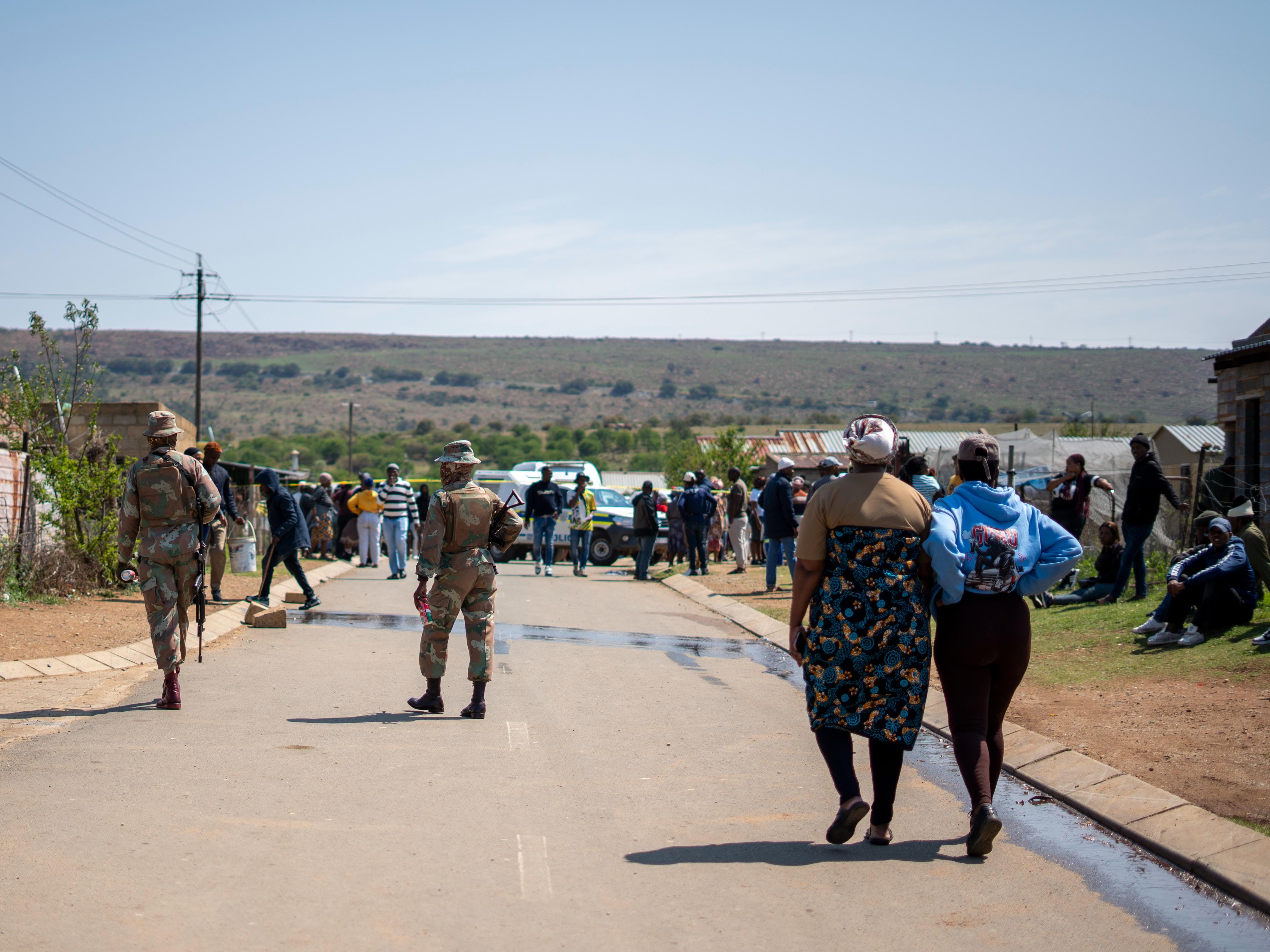
The recent wave included a fatal shooting at a tavern in Wedela, southwest of Johannesburg.
Photo journalist Rumana Akoob visited the scene of the mass murder in this area shortly after and filed some really shocking images.


But while we are all shocked and scared somewhat, I wanted to focus on the WHY.
I reached out to anti-crime activist Yusuf Abramjee, who explained things to us in a succinct voice note that you can listen to above.
He explained that some 120 people have been killed in mass shootings across the country since the beginning of the year.
I wanted to understand what it would take to stop these attacks, rather than simply respond to them after the fact.
Abramjee has an interesting take. He says that we are approaching mass shootings as individual crimes when we should also be investigating the criminal networks that make them possible.
“We are not dealing with ordinary street crime.”
He points to organised criminal networks, illegal firearms, gang activity and what he describes as a serious breakdown in the state’s ability to prevent violent crime.
That is an important distinction because our response to a mass shooting usually follows a familiar pattern. Police arrive at the scene, investigations begin, politicians condemn the killings and there are promises to bring the perpetrators to justice.
All of that is necessary. But it raises a question that deserves much more attention: what was happening before the shooting, and could it have been stopped?
Abramjee wants government to focus on five things, beginning with illegal firearms.
“Every illegal gun is a potential murder weapon”
The obvious response to gun violence is to get illegal guns off the streets. But recovering a firearm after a shooting is not the same as disrupting the network that supplied it.
If investigators arrest a gunman but leave the people supplying weapons untouched, that network can continue operating.
This is why Abramjee’s fourth proposal, which is to target the kingpins and financiers behind organised crime, is closely linked to his first.
“Arresting the person holding the gun is not enough if the people supplying the weapons and financing the criminal networks remain untouched.”
In other words, the investigation cannot end with the person who pulled the trigger. It also needs to establish who supplied the weapon, who financed the operation and whether the shooting forms part of a wider criminal network.
That is a more complicated investigation than making an arrest at a crime scene, but it gets closer to the question of how these attacks can be prevented.
What did the police know before the shooting?
The second part of Abramjee’s proposal is to strengthen police intelligence and investigative capacity.
“Mass shootings don’t happen in a vacuum.”
His point is that there are often warning signs before an attack, including criminal rivalries, threats and networks operating behind the scenes.
This is where the difference between reactive and proactive policing becomes important.
Reactive policing begins once a crime has happened. Officers respond to the scene, collect evidence and try to identify the perpetrators.
Proactive policing tries to identify threats before they become crimes.
Abramjee’s argument is that where shootings are linked to criminal networks or rivalries, intelligence officers should be working to identify those threats before people are killed.
That does not mean every attack can be predicted. It means the police need the capacity to investigate threats and disrupt criminal activity before it escalates into a mass shooting.
It also means intelligence cannot operate in isolation from the detectives who investigate crimes and the prosecutors who must eventually take cases to court.
This brings us to his third proposal: properly resourced specialist teams.
Abramjee wants detectives, intelligence officers, forensic specialists and prosecutors working together on mass shootings and organised crime.
There is a practical reason for this. A detective may be investigating the shooting itself, while intelligence officers have information about a criminal network and forensic specialists are examining the weapons or evidence. Prosecutors need evidence that can stand up in court.
If those parts of the investigation do not work together, it becomes much harder to build a case against the people directing or financing the violence.
And arresting someone is only one part of the job. The state must also be able to prosecute them successfully.
Why communities need to be part of the response
Abramjee’s final proposal is about community involvement and whistleblower protection.
This is perhaps the most difficult part of the conversation because we often hear calls for communities to work with the police without asking what happens to people who come forward.
Residents may have information about threats, criminal activity or illegal firearms. But sharing that information can be dangerous, particularly when the people involved are part of organised criminal networks.
“People need safe and credible channels to report information and whistleblowers need protection.”
What I found useful about Abramjee’s proposals is that they shift the conversation away from what government says immediately after a mass shooting and towards what the state should be doing every day.
None of these interventions are a quick fix. Abramjee’s argument is that the response has to be sustained long after the initial outrage has faded.
“Mass shootings are not inevitable.”
He says the state has a responsibility to protect lives and that its response must be “urgent, coordinated and sustained”.
I think that is the question we should be asking whenever another mass shooting makes the news. Not only whether the police will arrest the perpetrators, but whether the state is doing enough to prevent the next attack.


